Calgary Business Valuation | Pin.ca
Defensible Fair Market Value Reports in Just 10 Days - Basic Flat Fee $3,500

Eric Jordan
CPPA
Our comprehensive business valuation reports identify, measure, weigh, and value both tangible and intangible assets using the Eric Jordan 25 Factors Affecting Business Valuation methodology and when possible the Eric Jordan “5 Senses Inspection Report” methodology.
This is a Comprehensive Fair Market Value Report comparable to full-scope, independent, litigation-ready valuation reports used in the United States, United Kingdom, Australia, and other Western jurisdictions.
Not to be confused with lower-scope estimate or calculation reports that are often priced higher despite involving substantially less investigation, analysis, corroboration, and evidential support.
We use "Unbias Facts" to define "Fair Market Value"
Why Traditional Approaches Fail Without Calibration
Valuing a business by using the asset, income, and market approaches is like trying to make concrete using only gravel, cement, and steel rebar with a certified but uncalibrated portion percentage controller in the mixing machine.
DANGEROUS FOR THE END RESULT AND ANYONE DEPENDING UPON IT.
While asset, income, and market approaches can add support, using these approaches without being properly calibrated for scope and purpose in "estimate" and "calculation" reports, could mislead lawyers, clients, courts, and anyone the valuator should have known would depend upon the report.
Pin.ca only produces COMPREHENSIVE reports that take scope and purpose into consideration and has no capacity to produce the lesser or lower "estimate" or "calculation" reports that could misrepresent purpose and or scope.
Private Company Valuation Specialization
We specialize exclusively in private company valuation and appraisal assignments where intangible assets, operational realities, management capability, systems, customer relationships, goodwill components, and market position often comprise the majority of enterprise value.
Public company valuation models rely heavily on stock market comparables and institutional trading data, unlike the Eric Jordan 25 Factors Affecting Business Valuation methodology that is specifically designed for privately held businesses, where intangible assets and operational realities drive fair market value.
Check out; PIN.ca - Business Valuation Calgary.
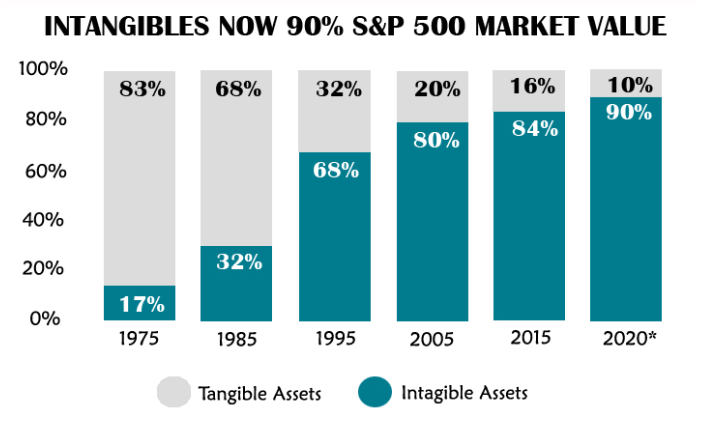
Intangible Assets Now Drive Business Value
For years, Ocean Tomo studies commonly cited an approximate 90% intangible / 10% tangible relationship within the S&P 500.
The latest 2026 release, using year-end 2025 data, moved that relationship further to approximately 92% intangible assets and 8% tangible assets.
“In Canadian private-company FMV work prepared for divorce, shareholder dispute, estate, tax, and expropriation purposes, granular factor-by-factor intangible identification with explicit weighting is rare at the price points and scopes where most engagements occur.”
I do this work as standard practice, under a published methodology, regardless of engagement size. That is not unique in the profession, but it is uncommon at this scope and price point, and the consequence for parties who didn't get it can be significant when discovery happens years later.
Decades of Experience in AI & Search
In addition to more than 40 years of experience as a hands-on business owner and operator working with both tangible and intangible assets, Eric Jordan spent 28 of those years engaged with search engine technology the early foundation of what later evolved into artificial intelligence even before Google was established.
He worked extensively in SEO and was aware of the development of neural network research emerging from Toronto and Montreal, much of which was later acquired and expanded upon by Silicon Valley companies in the evolution of modern AI platforms.
Over the years, he has studied both the opportunities and the limitations associated with artificial intelligence, including the practical risks tied to its use in business, valuation, and decision-making environments.
His ongoing commitment to understanding advancing technologies is reflected in his continued research and education, including completing AI studies through the University of Helsinki in 2026.
“Certification” without “calibration” can be dangerous
Why Calibration Matters in Business Valuation
The Core Principle: Real-World Examples
In 2025, we completed a business valuation assignment for a Vancouver company specializing in the calibration of large-scale HVAC systems used in high-rise buildings. These systems can be worth millions of dollars, and their business rests upon one critical principle: calibration. Without proper calibration, even certified systems may create significant operational and financial risk.
Experience Over Formulas
Eric Jordan, CPPA, International Business Valuation Specialist, delivers private company valuations grounded in more than 40 years of hands-on owner-operator experience together with practical operational analysis extending beyond formulas, templates, or standardized financial modeling.
This experience-based approach is intended to support the proper identification, measurement, and weighing of both tangible and intangible assets, particularly in matters involving dispute resolution, financing, succession planning, or litigation support.
Identifying Hidden Risks & Assets
In privately held businesses, intangible assets often represent a substantial portion of total enterprise value. Where these assets are not fully identified, investigated, corroborated, or considered, the resulting valuation may be materially incomplete.
If you have concerns about whether a past valuation fully reflected operational realities or intangible asset considerations, a preliminary review may help determine whether additional analysis is warranted.
In some jurisdictions and under certain circumstances, legal discovery and limitation periods may extend many years into the past. In situations where a valuation is materially challenged, questions regarding professional standards, intended reliance, scope adequacy, or associated errors and omissions (E&O) considerations may arise.
A properly prepared valuation is not simply a number. It is an analysis designed to be understandable, supportable, and capable of withstanding meaningful scrutiny.
Careful calibration, operational analysis, and proper consideration of intangible assets can help reduce the risks associated with materially incomplete valuation conclusions.
This same principle, grounded in operational realities and the proper identification of intangible assets, can contribute to more informed, efficient, and durable dispute resolution outcomes for privately held business owners.
Business Valuation for Dispute Resolution, Litigation, and Fair Market Value in Calgary
Over 95% of business disputes are resolved without going to court.
We provide the valuation data that makes fair, timely settlements possible.
At PIN.CA, we recognize that most business owners, shareholders, and stakeholders want a clean exit not years of litigation. Traditional accounting-based valuations often fail to capture the real drivers of value, particularly intangible assets that determine how a business actually performs in the marketplace.
Our methodology bridges formal valuation standards, including current and emerging CBV guidelines, with real-world operational reality. The result is defensible Fair Market Value conclusions that support resolution rather than fuel conflict.
1. Collaborative Valuation for Dispute Resolution
Our primary service, designed for the 95% who want to settle, move forward, and protect capital.
Instead of opposing experts battling over spreadsheets, we facilitate a transparent, stakeholder-focused valuation process. Using the 25 Factors Affecting Business Valuation together with the 5 Senses Inspection Report, we identify and document both tangible and intangible assets that are routinely overlooked in conventional reports.
What this delivers:
- Clarity:Canada-Alberta Memorandum of Understanding (MOU)
- Credibility: Intangible assets identified, measured, and explained in plain language
- Momentum: Valuations completed quickly to keep negotiations moving
Engagement terms:
- Fixed cost: $3,500 flat fee
- Timeline: Typically completed within 10 days
- Framework: Collaborative, documented, and designed to reduce conflict rather than escalate it
This approach is specifically structured to bridge gaps between expectations using objective evidence, not assumptions.
2. Litigation and Court-Directed Valuation Services
For the small minority of cases where court involvement is unavoidable.
When a matter proceeds to litigation, we provide independent, technically rigorous valuation work suitable for judicial scrutiny.
Independent, Court-Directed Valuation
When engaged as a neutral expert, our duty is to the court. We determine Fair Market Value by identifying, measuring, and explaining both tangible and intangible assets using normalized financials and documented operational evidence.
3. Valuation Report Review and Critique
We also act as independent consultants to review existing valuation reports. In this role, our duty is to you alone. We assess reports against accepted valuation standards and guidelines, identify unsupported assumptions, highlight overlooked assets, and clearly explain where methodology diverges from market reality.
Business Valuation Is Not Accounting
Accounting reports the past; business valuation in Calgary withstands present scrutiny for CRA, courts, and disputes.
Traditional reports use accounting templates, but modern business value stems from intangible assets like systems, relationships, positioning, risk, and operational reality often 90% of a private business's value.
Many business valuations fail CRA audits, litigation, financing, or shareholder disputes because math alone isn't enough.
Why Most Business Valuations Collapse Under Scrutiny
Most fail due to unidentified intangible assets, unmeasured value drivers, or undefendable conclusions in Canadian courts or CRA reviews.
In a global economy where 68% of wealth is intangible, traditional business valuation models are incomplete.
Frequently Asked Questions: Business Valuation in Calgary
"We provide business valuations in Calgary based on demonstrated performance and measurable assets,
not assumptions or labels. Results, risk, and replicability determine value."
Built for Cross-Examination in Canadian Courts
Cross-examination tests business valuations. If not explainable, defendable, and evidence-backed, they fail in court, CRA audits, litigation, or financing.
PIN.ca business valuations are pressure-proof from the start.
The PIN.ca Forensic Business Valuation Methodology
Eric Jordan 25 Factors Affecting Business Valuation™
Replaces goodwill guesswork with structured analysis of value drivers for accurate FMV reports.
5 Senses Inspection Report™
Desk valuations fail; forensic inspections provide observed facts for unchallengeable evidence in CRA and court settings.
Together, they create a forensic record of reality for your business valuation needs.
In Canadian Courts, CRA Audits, and Real Markets
- Used in Canadian litigation under cross-examination
- 20+ CRA-accepted business valuation reports without pushback
- 10-year validation: 2016 valuation sold at exact value; buyer returned for exit valuation
- Informed by 43 Canadian judicial decisions on business valuation
"Under cross-examination, Eric Jordan's valuation shone brightly and withstood scrutiny."
Ontario Self-Litigant
Calgary Business Valuation Landscape - 2026
In 2026, the Canadian business valuation landscape is defined by "Regulatory Predictability vs. Demographic Deceleration." While the U.S. and other global markets are currently experiencing extreme volatility due to shifting trade policies and "AI-bubble" concerns, Canada has carved out a distinct niche as a high-certainty, high-incentive environment for specific sectors.
From a valuation perspective, here is what differentiates Canada from the rest of the world in 2026:
1. The "Clean Economy" DCF Booster
The single biggest differentiator in 2026 is the maturity of Canada's Investment Tax Credits (ITCs).
- The Refundable Edge: Unlike the U.S. Inflation Reduction Act, which often relies on complex tax-equity partnerships, Canada's ITCs (Clean Tech, Hydrogen, CCUS) are refundable.
- Valuation Impact: When valuing a Canadian manufacturing or energy firm, we are looking at a direct cash injection. A $500k solar/green retrofitting investment can yield a $150k refund from the CRA, regardless of tax liability.
2. Labor Markets: "The Great Recalibration"
In 2026, Canada is the only G7 nation undergoing a coordinated reduction in immigration targets (stabilizing at 380,000 permanent residents).
- Wage-Push Inflation: After years of labor surplus, 2026 sees a tightening in skilled trades and healthcare.
- Differentiator: Valuations of tech and industrial firms now include a "Talent Stability Premium" because immigration slots are tied directly to high-skill employer needs.
3. Fiduciary Duty: The "BCE" Standard
A critical legal differentiator in 2026 is the BCE Inc. v. 1976 Debentureholders precedent.
- Canada vs. USA: In the U.S. (Delaware law), directors primarily owe a duty to maximize shareholder value. In Canada, directors owe a duty to the corporation itself.
- Valuation Impact: When valuing a minority stake in a Canadian firm, the "Control Premium" is often lower because a 51% owner has more legal guardrails.
4. Taxation: The Small Business "Safe Haven"
While the 2026 global "Pillar Two" agreement ensures a 15% minimum tax for massive multinationals, Canada's Small Business Deduction remains a global outlier for mid-market firms.
- The 9-11% Bracket: Most CCPCs pay only 9% to 11% on the first $500k of income.
- Global Comparison: In 2026, this creates a "Retained Earnings Moat," allowing Canadian mid-market firms to self-fund growth and R&D at a rate that high-tax jurisdictions cannot match.
5. Trade Strategy: The "CUSMA 2026 Review"
As we enter the mandatory Joint Review of CUSMA (USMCA) in mid-2026, Canada is positioned as a "Trusted Supplier."
- The "Proof of Origin" Premium: Valuations for Canadian exporters now include a "Tariff-Shield" analysis.
In 2026, Canada is a "Precision Market." We value based on Efficiency Multiples - how well a firm uses the "Alberta Tax Shield," "SR&ED Refunds," and "Clean Tech ITCs" to protect margins in a slow-growth global economy.
Why PIN.CA
- Focus on resolution first, not procedural escalation
- Specialized expertise in intangible asset identification and valuation
- Clear, fixed pricing with no hourly surprises
- Reports designed to be understood by owners, advisors, opposing parties, and the court
Who Uses PIN.ca Business Valuation Services in Calgary
- Business owners seeking accurate FMV
- Lawyers and self-litigants in disputes
- Accountants needing defensible valuation support
- Lenders and private financiers
- Buyers and sellers of businesses
- Shareholders in partnership disputes
- Cross-border clients requiring Calgary valuations
Hire a Business Valuation Specialist in Calgary, Not a Generalist
Serious outcomes demand specialists, not templates. For business valuations that survive scrutiny in CRA audits or Canadian courts, choose differently.
For Calgary business owners, business valuation is the forensic determination of
20 in-depth guides covering every major valuation scenario faced by Canadian business owners, lawyers, accountants, and shareholders.
What Is the Fair Market Value of My Business?
FMV is the legal standard used by CRA, courts, and every serious buyer. Here's exactly how it's determined.
Read: Fair Market Value Guide →Fair Value vs. Fair Market Value in Calgary
Two standards that look similar but produce very different numbers. The choice can shift results by 30–40%.
Read: Fair Value vs FMV Guide →What Is Goodwill in a Business Valuation in Calgary?
The most commonly used and most commonly misused concept in valuation. Not an asset; a category for what wasn't individually identified.
Read: Goodwill Valuation Guide →How to Value Intangible Assets in a Canadian Small Business
Most valuations lump everything into goodwill. Here's how to actually identify and value the assets that represent up to 90% of worth.
Read: Intangible Assets Guide →Business Valuation for Divorce in Calgary
If you or your spouse owns a business, it must be valued. Here's what it costs, how the process works, and what courts expect.
Read: Divorce Valuation Guide →Business Valuation for Shareholder Buyout in Calgary
When a shareholder leaves voluntarily or not shares must be valued. The standard of value matters more than the methodology.
Read: Shareholder Buyout Guide →Shareholder Agreement With No Valuation Method: What Happens?
When a shareholder agreement is silent on valuation, Canadian courts must decide. Here's how they handle it.
Read: Shareholder Agreement Guide →Oppression Remedy Valuation in Ontario
Uses fair value not FMV meaning minority discounts are typically excluded. Here's what courts need and how evidence changes outcomes.
Read: Oppression Remedy Guide →Can a Business Valuation Be Challenged in Court in Calgary?
Yes every valuation submitted as evidence can be challenged. Here are the most common grounds and how to make your report resistant.
Read: Court Challenge Guide →Business Valuation for a Section 86 Estate Freeze in Calgary
Your accountant structures the freeze. Your lawyer drafts the documents. But the valuation is what CRA scrutinizes sometimes years later.
Read: Estate Freeze Guide →Normalizing Financial Statements for Business Valuation in Calgary
A $500,000 business can appear to earn $80,000 or $250,000 depending on adjustments. Here's why normalization is critical.
Read: Normalization Guide →Owner Dependency Discount in Business Valuation
The single most common reason a business is worth less than its owner expects. Here's how it's identified, measured, and reduced.
Read: Owner Dependency Guide →Why Comparable Sales Are Wrong for Business Valuation
The most commonly used and least reliable method for private businesses. Here's why comparable sales data is structurally flawed.
Read: Comparable Sales Guide →CBV vs CPPA for Business Valuation in Calgary
Comparing Calgary's two main valuator designations what each credential requires and what it tells you about the report quality.
Read: CBV vs CPPA Guide →How to Increase Business Value Before Selling in Calgary
A valuation-driven roadmap showing which of the 25 Factors to address first and how each improvement translates into measurable value.
Read: Value Increase Guide →Business Valuation Report Example Calgary
A section-by-section walkthrough of what a well-prepared report contains and the red flags that signal a weak one.
Read: Report Example Guide →Business Valuation for a Bank Loan in Calgary
When and why Canadian lenders require a valuation, and how a lending valuation differs from one prepared for sale or divorce.
Read: Bank Loan Valuation Guide →Business Valuation for a CSBFP Loan in Calgary
How to get a valuation that satisfies Canada Small Business Financing Program requirements for loans up to $150,000.
Read: CSBFP Loan Guide →Franchise Valuation for Sale in Calgary
A franchise is not valued like an independent business. The franchise agreement fundamentally changes the analysis and what a buyer actually purchases.
Read: Franchise Valuation Guide →Expropriation Business Valuation in Calgary
When the government takes your property, compensation extends beyond land value including goodwill destruction and disturbance damages.
Read: Expropriation Guide →Calgary Business Valuation Landscape - 2026
In 2026, Calgary stands as a unique case study in business valuation. While much of the world grapples with stagnant growth or "growth at any cost" models, Calgary has entered a phase of disciplined diversification. From a valuation perspective, the city is no longer just a proxy for oil prices it is a high-yield, lower-risk alternative to the overheated tech hubs of the coasts.
1. The Stability Premium in Real Estate
In 2026, while Toronto and Vancouver are undergoing a "reset" characterized by flat or declining prices and high speculation risk, Calgary's market is defined by fundamental stability.
Inventory vs. Absorption: Unlike the 2021-2023 frenzy, 2026 sees a balanced-to-buyer-leaning market. For a business valuation, this means lower occupancy cost volatility businesses can project long-term lease or ownership costs with much higher certainty than in other major Canadian metros.
The Conversion Play: Calgary leads the world in office-to-residential conversions. From a valuation standpoint, this has "mopped up" excess office supply that would have otherwise depressed downtown commercial values, effectively setting a floor for commercial real estate multiples in the core.
2. Advanced Energy & The MOU Catalyst
Calgary remains the energy capital, but the nature of the assets has shifted. The Canada-Alberta Memorandum of Understanding (MOU), with key milestones hit in April 2026, has fundamentally changed how we value energy-related firms.
Carbon Pricing Certainty: The finalization of the carbon pricing equivalency agreement ($130/tonne) provides a "known variable" for DCF models. This removes the regulatory fog that previously led to higher discount rates for Alberta-based energy firms.
Clean-Tech Integration: Valuations for Calgary firms now frequently include intangible energy assets proprietary CCUS (Carbon Capture, Utilization, and Storage) tech and methane reduction patents. These companies are being valued more like tech firms than traditional service rigs.
3. Tech Growth vs. Cost of Talent
Calgary has the fastest-growing tech workforce in North America (70% growth since 2018). The cost of a senior software engineer in Calgary is still significantly lower than in Silicon Valley or Seattle, but the quality of life and "stickiness" of talent (due to housing affordability) is higher.
Valuation Impact: This leads to higher EBITDA margins for Calgary-based startups compared to their coastal counterparts. Turnover risk is lower, which justifies a higher multiple on earnings.
4. The Tax Shield Advantage
Alberta's 8% corporate tax rate remains the lowest in Canada. Compared to the 11-12% seen in other provinces, this 3-4% difference is a direct bottom-line booster. In a 2026 environment where global interest rates have squeezed margins, Calgary businesses have a built-in cushion that increases NPV relative to a twin business in Ontario or BC.
5. Strategic Logistics: The Prairie Economic Gateway
Calgary has successfully transitioned into a global inland port. With the expansion of the Prairie Economic Gateway, industrial valuations (warehousing, cold storage, and logistics) have seen a 3% growth in 2025/2026, even as other sectors cooled. Companies involved in manufacturing or e-commerce benefit from a logistical "moat" due to proximity to USMCA-compliant export routes and Asian energy markets via the west coast.
2026 Valuation Comparison: Calgary vs. Vancouver vs. Toronto
| Metric | Calgary | Vancouver | Toronto |
|---|---|---|---|
| Primary Valuation Anchor | Energy + Diversification | Port & Real Estate | Finance & AI |
| Corporate Tax Rate (SME) | 8% + No PST | 11% + PST | 11.5% + HST |
| Talent Retention Risk | Low (housing affordable) | High (housing crisis) | High (wage inflation) |
| CCUS / Clean-Tech Intangibles | Yes significant | Minimal | Minimal |
| Logistics Premium | Prairie Gateway + USMCA | Port-dependent | 400-series congestion |
| CBV Standard Capture | Partial (gaps exist) | Adequate | Adequate |
The Specialist's Verdict
Calgary in 2026 is a Value Extraction market defensible cash flow at reasonable multiples, with Canada's lowest tax environment and a housing market that keeps talent accessible. But standard CBV 2026 models are systematically undervaluing Calgary businesses by failing to capture the Conversion Floor, the CCUS intangible premium, the talent retention advantage, and the Prairie Gateway logistics moat.
PIN.ca's 25 Factors Affecting Business Valuation and 5 Senses Inspection Report are specifically designed to surface these gaps and build them into a defensible, court-ready FMV conclusion that reflects Calgary's actual 2026 market reality.
Frequently Asked Questions: Business Valuation in Calgary
- What is the cost of a business valuation in Calgary?
- PIN Valuations offers a flat-fee business valuation starting at $3,500 CAD, completed within 10 business days. This includes a defensible Fair Market Value report suitable for CRA, litigation, divorce, or shareholder disputes in Calgary and across Alberta.
- How does Alberta's tax environment affect business valuation in Calgary?
- Alberta's no-PST environment and low corporate tax rate (9–11% for CCPCs) mean Calgary businesses consistently show higher normalized after-tax earnings. This directly increases Fair Market Value conclusions compared to otherwise identical businesses in Ontario or BC.
- Can a Calgary business valuation be used in a CRA audit?
- Yes. Eric Jordan, CPPA has produced 20+ CRA-accepted business valuation reports without pushback. A defensible FMV report prepared using the 25 Factors methodology and 5 Senses Inspection is specifically designed to withstand CRA scrutiny.