Defensible Fair Market Value Reports in Just 10 Days Basic Flat Fee $3,500
Eric Jordan
CPPA
Our comprehensive business valuation reports identify, measure, weigh, and explain both tangible and intangible assets using the Eric Jordan 25 Factors Affecting Business Valuation methodology.
The 25 Factors Affecting Business Valuation™ is a court-accepted proprietary framework designed to identify and quantify the 68% intangible core of a private business that traditional accounting models routinely miss. Unlike simple "multiples," this methodology defines value through 25 distinct forensic lenses from Purpose and History to Client Base and Special Interest Purchaser.
By weighting these factors through the calibrated judgment of 28 years of owner-operator experience, we provide an unshakeable determination of Fair Market Value that is built for the high-stakes reality of Canadian litigation and disputes.
The 25 Factors Affecting Business Valuation Methodology
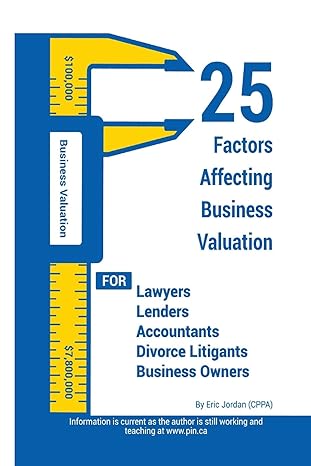
The 25 Factors Affecting Business Valuation methodology was first published in book form by Eric Jordan CPPA on September 17, 2017, and made available in paperback and Kindle editions on Amazon, Barnes & Noble, Google Books, and major retail platforms worldwide.
This is not a self-published document in any casual sense of the term. It is a government-registered, commercially distributed, multi-platform, dual-format professional publication carrying a registered Canadian ISBN recorded in national bibliographic databases and independently listed across multiple commercial and academic platforms.
The work was written specifically for business owners, lawyers, lenders, and litigation professionals who need to understand what traditional asset, income, and market valuation approaches systematically miss.
As the book states: if traditional business valuations were correct, Amazon investors would have all lost their money and Amazon would have failed.
Since 2017, the methodology has been continuously refined through real-world Canadian and international valuation engagements. The current version represents nearly a decade of refinement and has been applied in Canadian litigation as a court-accepted methodology for identifying the 68% intangible core of modern business value.
25 Factors Affecting Business Valuation Book by Eric Jordan CPPA
What is the purpose of the business valuation? Divorce, expropriation, tax reasons, internal use, or dispute with partners, shareholders, or directors?
Purpose also explains why the business exists beyond making money. A clear, lived-in purpose aligns decision-making, attracts customers, and sustains value during stress. Businesses without a defined purpose drift, and drift destroys valuation faster than bad accounting.
WHY?
These are examples of how this factor can be used in a business valuation:
1. Ottawa: The Specialized Defense/Tech Firm
Scenario: A boutique cybersecurity firm in Kanata specializing in protecting federal government infrastructure.
The "Drift" Risk: If the firm's purpose is just "securing contracts," a change in procurement policy or a lost RFP could crater its value overnight.
The Purpose Value: If the purpose is "To safeguard Canada's national digital sovereignty," the firm builds deep, non-commodity relationships with the CSE and DND.
Valuation Impact: When valuing the company for an acquisition, the appraiser sees the purpose-driven alignment as a barrier to entry for competitors. This reduces the risk profile (cap rate), leading to a higher multiple on recurring revenue because the "Purpose" ensures the firm remains an essential partner to the state rather than just another vendor.
2. Toronto: The Legacy Financial Services Boutique
Scenario: A multi-generational wealth management firm in the Financial District facing a transition to a new owner.
The "Drift" Risk: Without a defined purpose, clients often follow the departing founder, viewing the firm as a mere vehicle for the individual's talent. The goodwill is personal, not corporate.
The Purpose Value: A firm with a purpose like "Protecting the multi-generational legacies of Toronto's immigrant entrepreneurs" creates a brand that exists independently of the founder.
Valuation Impact: In a shareholder dispute or sale, Factor 1 allows the validator to argue for Institutional Goodwill. The purpose-driven culture attracts a specific "sticky" client base that is less sensitive to fee competition from big banks, justifying a premium on the Intangible Assets.
3. Halifax: The High-Growth Marine Tech Startup
Scenario: An ocean-tech company in the COVE (Centre for Ocean Ventures and Entrepreneurship) ecosystem developing sustainable fishing sensors.
The "Drift" Risk: A company chasing "VC exits" might pivot too often, burning through talent and losing the trust of the local Atlantic fishing community.
The Purpose Value: A company with a lived-in purpose "To ensure the North Atlantic remains a productive resource for the next 100 years" aligns its decision-making with environmental regulators and local stakeholders.
Valuation Impact: During a 5 Senses Inspection, the "vibe" of the workplace and the community's perception of the brand reflect this purpose. This creates "Social License to Operate," which is a massive risk-mitigation factor in Atlantic Canada. A business with this alignment is far more resilient to "stress" (like seasonal shifts or regulatory changes), sustaining its valuation when others might falter.
History tells the story of how the business survived, adapted, and evolved. Lenders and buyers care less about perfection and more about resilience. A business that has navigated downturns, competition, and change carries embedded value that spreadsheets alone can't capture. The private business owner operator after 10 or 15 years, has developed that gut brain instinct like a pilot or a surgeon.
WHY?
These are examples of how this factor can be used in a business valuation:
1. Calgary: The Cyclical Energy Services Firm
Scenario: A field services company founded during the late-1980s oil downturn that survived multiple boom-bust cycles.
The "Drift" Risk: Treating history as nostalgia causes buyers to discount survival as luck rather than skill.
The History Value: The firm's operating decisions were shaped by scarcity, discipline, and capital restraint.
Valuation Impact: History demonstrates proven resilience under stress, lowering perceived volatility and supporting a stronger multiple than a younger, untested competitor.
2. Hamilton: The Multi-Generation Manufacturer
Scenario: A metal fabrication company passed down through three family generations.
The "Drift" Risk: Ignoring history reduces the business to machinery and margins alone.
The History Value: Institutional knowledge is embedded in processes, supplier relationships, and workforce norms.
Valuation Impact: The appraiser recognizes continuity as an intangible asset that reduces transition risk and stabilizes normalized earnings.
3. St. John's: The Marine Services Operator
Scenario: A port services company operating continuously since the cod moratorium.
The "Drift" Risk: Viewing the business as "still standing" undervalues regulatory navigation skill.
The History Value: The company adapted while peers disappeared.
Valuation Impact: History proves regulatory competence, justifying reduced risk discounts in a highly controlled industry.
Financials show what happened but not always why. Proper valuation looks past raw numbers to normalized earnings, owner adjustments, and sustainability. Anyone can read statements; experienced operators know when the numbers lie politely.
We need to know why and how.
WHY?
These are examples of how this factor can be used in a business valuation:
1. Toronto: The Professional Services Firm
Scenario: A professional services firm shows ten years of clean, consistently prepared financial statements.
The "Drift" Risk: If financials are treated as mere compliance documents, they say little beyond revenue and profit.
The Financials Value: In reality, they reflect disciplined pricing, controlled growth, and deliberate capital allocation. That consistency signals management maturity.
Valuation Impact: In valuation, predictable, decision-driven financials reduce uncertainty, support lender confidence, and justify a higher multiple than a firm with similar earnings but erratic reporting history.
2. Vancouver: The Construction-Adjacent Business
Scenario: A construction-adjacent business shows volatile revenue tied to development cycles.
The "Drift" Risk: Without proper segmentation, volatility appears excessive.
The Financials Value: Once financials are broken down by service line, stable recurring work emerges beneath cyclical projects. This clarity allows risk to be priced accurately rather than broadly discounted.
Valuation Impact: In valuation, segmentation preserves value that would otherwise be lost to blunt risk assumptions.
3. Edmonton: The Owner-Operated Industrial Contractor
Scenario: An owner-operated industrial contractor historically underpaid ownership.
The "Drift" Risk: Failing to normalize underpaid ownership distorts true profitability.
The Financials Value: Once normalized, true profitability appears lower but credible.
Valuation Impact: That credibility strengthens valuation conclusions for financing.
ROI measures how efficiently capital is converted into profit after fair wages and real costs. True ROI reflects what an arms-length investor would earn not what an owner working 80 hours a week convinces themselves is "profit."
This is where we have to correctly understand "normalization," which can't be done without experience.
WHY?
These are examples of how this factor can be used in a business valuation:
1. Mississauga: The Logistics Services Company
Scenario: A logistics services company operates with minimal fixed assets and long-term contracts.
The "Drift" Risk: If valuation focuses only on revenue size, the firm appears unremarkable.
The Return on Investment Value: Its true strength is exceptional return on invested capital. Each dollar deployed produces reliable cash flow.
Valuation Impact: In valuation, high ROI signals capital efficiency and attracts strategic buyers, supporting strong value despite modest top-line numbers.
2. Brampton: The Food Processing Business
Scenario: A food processing business operates on thin margins in a competitive market.
The "Drift" Risk: Viewed superficially, profitability looks weak.
The Return on Investment Value: However, rapid inventory turnover and disciplined capital use produce strong returns. ROI reveals management effectiveness where margin analysis fails.
Valuation Impact: In valuation, this reframing prevents undervaluation driven by headline margins alone.
3. Winnipeg: The Equipment Leasing Firm
Scenario: An equipment leasing firm produces steady returns across cycles.
The "Drift" Risk: While growth is modest, consistent ROI demonstrates durability.
The Return on Investment Value: Stability offsets growth limitations.
Valuation Impact: In valuation, stability offsets growth limitations and supports defensible long-term value.
Liquidity assesses how easily assets or the business itself can be converted to cash. Illiquid businesses require longer exits, higher discounts, or specialized buyers. Liquidity risk is often invisible to owners until it's painfully real.
WHY?
These are examples of how this factor can be used in a business valuation:
1. Vancouver: The Hospitality Group
Scenario: A hospitality group holds transferable licenses, modern equipment, and favorable lease assignments.
The "Drift" Risk: Hospitality is often assumed illiquid, but this business has multiple exit paths.
The Liquidity Value: Assets can be sold individually or as a going concern.
Valuation Impact: In valuation, liquidity reduces worst-case downside risk, strengthening valuation floors and buyer confidence.
2. Victoria: The Regulated Healthcare Clinic
Scenario: A regulated healthcare clinic maintains transferable patient rosters and professional licenses.
The "Drift" Risk: If goodwill is assumed personal, liquidity is understated.
The Liquidity Value: In reality, the practice can be monetized efficiently.
Valuation Impact: In valuation, this liquidity supports a premium on intangible assets because exit risk is lower than in unregulated services.
3. Kelowna: The Trades Business
Scenario: A trades business owns mobile equipment and services a broad client base.
The "Drift" Risk: Geographic mobility allows assets and contracts to retain value outside the local market.
The Liquidity Value: Geographic mobility allows assets and contracts to retain value outside the local market.
Valuation Impact: In valuation, liquidity assumptions are improved, reducing risk discounts.
Factor 6. Cost of Liquidation
Description
This factor sets the valuation floor. It asks: If this stopped tomorrow, what survives? Understanding liquidation cost protects buyers, lenders, and sellers from fantasy pricing and exposes fragile businesses early. A valuator need to understand the difference between liquidation and ongoing business with assets in place and working.
WHY?
These are examples of how this factor can be used in a business valuation:
Thunder Bay: The Remote Forestry Services Company
Sault Ste. Marie: The Specialized Industrial Repair Shop
Timmins: The Mining Support Services Operator
Factor 7. Hard Assets
Description
Hard assets include tools, equipment, machinery, inventory, and property. Their value depends on age, condition, market demand, and replacement cost not depreciation schedules dreamed up for tax purposes. A real valuation will show the value of the hard assets at FMV and not liquidation. Experience rules the day.
WHY?
These are examples of how this factor can be used in a business valuation:
Regina: The Agricultural Equipment Dealership
Saskatoon: The Specialized Processing Facility
Winnipeg: The Manufacturing Plant with Replacement-Cost Reality
Factor 8. Utility, Sustainability, and Scalability
Description
Utility asks if the business actually solves a problem. Sustainability asks if it can keep doing so profitably. Scalability asks whether growth increases value or simply increases headaches.
WHY?
These are examples of how this factor can be used in a business valuation:
Kitchener: The Automation-Enabled Manufacturing Firm
Waterloo: The Cross-Industry AI Services Company
Cambridge: The Industrial Systems Integrator
Factor 9. Research & Development (R&D)
Description
R&D can run both ways. It is money spent and does it reflect future earnings power, or just past expense. Whether formal or informal, investment in improvement, innovation, or efficiency creates intangible value that spreadsheets routinely miss because nobody is capable of identifying, measuring, weighting, and putting a dollar value on it.
WHY?
These are examples of how this factor can be used in a business valuation:
Guelph: The Agri-Food Product Innovator
Toronto: The Regulation-Driven FinTech Platform
Vancouver: The Clean-Tech Engineering Firm
Factor 10. Processes, Procedures, Systems, and Documentation
Description
Documented systems reduce dependence on specific people. A business that runs on process instead of personality is transferable and transferability is where real value lives.
WHY?
These are examples of how this factor can be used in a business valuation:
London, Ontario: The Standardized Healthcare Services Company
Barrie: The Systematized Trades Services Firm
Oshawa: The Automated Logistics Operator
Factor 11. Shareholder Agreement
Description
Shareholder agreements define control, exits, disputes, and death scenarios. Weak or missing agreements introduce uncertainty, and uncertainty is always priced as risk. There are shareholder agreements that don't reflect FMV and are not legal. Sometimes people can get bullied with these non compliant shareholder agreements.
WHY?
These are examples of how this factor can be used in a business valuation:
Calgary: The Multi-Partner Energy Services Firm
Red Deer: The Founder-and-Investor Construction Company
Lethbridge: The Multi-Sibling Family Agribusiness
Factor 12. Management Capability & Workforce
Description
This factor evaluates whether the business can operate without the owner. A capable management team and trained workforce convert into real, bankable value.
WHY?
These are examples of how this factor can be used in a business valuation:
Hamilton: The Middle-Managed Manufacturing Operation
Windsor: The Cross-Trained Automotive Supplier
Niagara: The High-Retention Hospitality Operator
Factor 13. Client Base
Description
A diversified, loyal client base reduces revenue risk. Over-reliance on a few customers or the owner's personal relationships creates fragility that buyers and lenders immediately discount. If the client base doesn't know who the owner is then the clients don't have a relationship with the owners that could impede a sale.
This is a wonderful thing and shows business strength.
WHY?
These are examples of how this factor can be used in a business valuation:
Moncton: The Embedded B2B Regional Services Firm
Fredericton: The Institutional Professional Services Practice
Saint John: The Port-Centric Industrial Services Provider
Factor 14. Supply Chain
Description
Supply chain stability affects cost, reliability, and scalability. Businesses with resilient, diversified suppliers weather shocks better and shocks are no longer hypothetical. I recently did a $225 Million USD valuation report for a company where the supply chain was critical to the company existence. Supply chain can be a double edge.
WHY?
These are examples of how this factor can be used in a business valuation:
Brandon: The Regionally Anchored Food Processing Company
Steinbach: The Dual-Sourced Specialized Manufacturer
Winnipeg: The Centrally Positioned Distribution Enterprise
Factor 15. Distribution Network
Description
Distribution determines how revenue actually reaches customers. Strong channels physical, digital, or contractual add leverage and defensibility to valuation. If the company has a 25 year supply reputation with multiple national retailers, it takes one of the major business hurdles right off the table.
WHY?
These are examples of how this factor can be used in a business valuation:
Surrey: The Multi-Channel Import and Wholesale Operator
Burnaby: The Relationship-Driven Wholesale Distributor
Richmond: The Port-Integrated Export Business
Factor 16. Marketing
Description
Marketing isn't expense; it's asset creation. Brand recognition, reputation, and audience trust create pricing power often the largest intangible asset on the balance sheet.
WHY?
These are examples of how this factor can be used in a business valuation:
Toronto: The Reputation-Led Professional Services Firm
Vancouver: The Lifestyle-Driven Consumer Brand
Montréal: The Culturally Differentiated Creative Firm
Factor 17. Dominance in the Market
Description
Market dominance doesn't require monopoly just relevance. Being the known option in a niche creates defensible value that competitors struggle to displace.
WHY?
These are examples of how this factor can be used in a business valuation:
Grande Prairie: The Regional Industrial Services Leader
Edmonton: The Industrial Niche Specialist
Calgary: The Category-Defining Professional Consultancy
Factor 18. Industry Benchmarks (Averages)
Description
Benchmarks provide context, not commandments. Experienced valuators know when a business should outperform averages and when averages are misleading or irrelevant.
WHY?
These are examples of how this factor can be used in a business valuation:
Kingston: The Above-Average Healthcare Services Operator
London, Ontario: The Education and Training Services Firm
Guelph: The Benchmark-Driven Manufacturing SME
Factor 19. Terms of Lease
Description
Lease terms affect risk, cash flow, and transferability. Favorable leases enhance value; restrictive or expiring leases quietly destroy it. It is one of the first things one should look at when doing a business valuation.
WHY?
These are examples of how this factor can be used in a business valuation:
Charlottetown: The Below-Market Downtown Retail Operator
Truro: The Long-Term Industrial Tenant with Renewal Security
Sydney: The Scarce Waterfront Commercial Operator
Factor 20. Terms of Sale
Description
Deal structure can matter more than price. Vendor financing, earn-outs, holdbacks, and warranties all shift risk and valuation must reflect who carries that risk.
Generally for private sales the sale price on the buy/sell agreement is not reliable. This is because they were under some kind of pressure to sell. Finances/Debt, Disease, Death, Divorce, Drugs. Without some kind of proof that the sale price was without any compulsion the data should be discarded. "My uncle's friend said" is not good enough.
WHY?
These are examples of how this factor can be used in a business valuation:
Peterborough: The Owner-Operated Services Business with Vendor Financing
North Bay: The Gradual Transition Regional Business
Cornwall: The Cross-Border Seller with Currency-Aware Structuring
Factor 21. Minority Interest
Description
Minority ownership lacks control and liquidity. That reality demands discounts, regardless of how emotionally attached an owner might be to their percentage.
WHY?
These are examples of how this factor can be used in a business valuation:
Brantford: The Multi-Owner Manufacturing Company
Oshawa: The Growth-Oriented Services Firm with Minority Capital
Guelph: The Professional Services Partnership
Factor 22. Special Interest Purchaser
Description
Some buyers see unique synergies others can't. Identifying special interest purchasers can unlock premiums but only if valuation separates strategic upside from fair market value.
WHY?
These are examples of how this factor can be used in a business valuation:
Nanaimo: The Regional Marine Services Acquisition Target
Kamloops: The Vertical Integration Opportunity
Victoria: The Lifestyle-Motivated Professional Practice Buyer
Factor 23. Geopolitical Considerations
Description
Regulation, trade policy, tariffs, labor mobility, and political stability increasingly affect valuation.
WHY?
These are examples of how this factor can be used in a business valuation:
Whitehorse: The Northern Logistics and Supply Company
Yellowknife: The Government-Funded Construction Contractor
Iqaluit: The Essential Community Services Provider
Factor 24. Risk
Description
Risk is the cumulative effect of all weaknesses, dependencies, and uncertainties.
WHY?
These are examples of how this factor can be used in a business valuation:
Prince George: The Resource-Linked Industrial Services Firm
Thompson: The Single-Client Infrastructure Contractor
Grande Prairie: The Cyclical but Diversified Regional Operator
Factor 25. Opportunity
Description
Opportunity reflects unrealized potential that a capable buyer could reasonably execute.
WHY?
These are examples of how this factor can be used in a business valuation:
Toronto: The Platform-Ready Professional Services Firm
Vancouver: The Brand Extension Consumer Business
Calgary: The Operational Turnaround Opportunity
A $770,000 Valuation Gap
I valued a private business at $2,759,740 using an earnings-based approach for tax purposes. Tangible assets: $1,523,399. Intangible assets: $1,236,341. I applied a multiple of 3.75.
A second opinion reduced the value to approximately $1,986,854, a difference of $772,886.
I believe the client took a substantial risk if he actually reported the $1,986,854 to the tax department. But that is between him and the tax department.
However, in a divorce or partnership, if this $1,986,854 undervaluation situation was discovered five or ten years after the fact, and our methodology was applied, showing the $2,759,740 value, we would expect a lawyer would be happy to take this on contingency and negotiate for half of the $772,886 plus interest and damages if it caused the liquidation of a valuable stock position or something similar.
A lot of recovery.
Our initial audit would be free, and for the full business valuation, we would only require a small deposit and allow the client to pay us the balance two years later at 4% yearly interest.
Everyone reading this probably knows someone who was disadvantaged over the past 15 years in a valuation dispute who would love to recover from the valuator's errors and omissions insurance.
I can produce all the documents of the situation above for a court in less than five minutes, but it would require a court order for me to do so.
Below is the near irrefutable evidence from experts to prove how our methodologies produce full and complete valuations. This is the information we expect to prevail. Read what the experts say and see if you agree with our conclusion.
Authorities Supporting the 25 Factors and the Five-Senses Inspection Report
The authorities listed below establish the intellectual, methodological, and legal basis for the 25 Factors Affecting Business Valuation and the Five-Senses Inspection Report. Together, they support the analytical framework, inspection approach, and professional conclusions reflected in this report.
Atul Gawande The Checklist Manifesto
Harvard Medical School; Brigham and Women's Hospital; WHO Safe Surgery Saves Lives program.
Work: The Checklist Manifesto: How to Get Things Right (2009). Publisher link: atulgawande.com
Specific support for the 25 Factors: Gawande’s central finding is that even highly credentialed experts systematically fail in complex environments when their methodology does not include a documented, sequential step that requires examination of every critical factor. His surgical checklist reduced complications and deaths by 35% across 20 countries not by replacing expert judgment, but by making the process complete, verifiable, and testable.
The 25 Factors is this type of instrument applied to business valuation: each factor is a mandatory documented step; none can be skipped or collapsed into an undefined reference to goodwill. A valuation methodology that contains no explicit step requiring identification of intangible assets will not identify them and will not even register their absence, which is exactly the failure mode Gawande describes in conventional complex practice.
Specific support for the Five-Senses Inspection Report: Gawande established that the discipline of a structured checklist requires physical presence at the subject being assessed. A checklist completed from memory or from documents provided by interested parties is a form, not a methodology.
The Five-Senses Inspection Report enforces on-site presence: it cannot be completed from a desk because each of its five components requires the inspector to be physically present, observing what is actually there, and recording what they encounter. This makes Gawande’s on-site process discipline operational in a business valuation context.
Daniel Kahneman Thinking, Fast and Slow
Nobel Prize in Economics (2002); Professor Emeritus, Princeton University.
Work: Thinking, Fast and Slow (2011). Publisher link: Macmillan
Specific support for the 25 Factors: Kahneman’s WYSIATI principle “What You See Is All There Is” shows that the mind forms conclusions from whatever is in front of it; factors that are never examined do not register as missing, they register as irrelevant.
In valuations built purely on financial statements and comparable sales data, the intangible assets that often represent the majority of a privately held business’s value are simply not present in the documents being reviewed; they appear not as a gap but as silence. Kahneman’s research at financial institutions demonstrated that unstructured expert judgment can vary 40% to 60% between practitioners evaluating identical cases.
The 25 Factors methodology addresses this directly: a structured, enumerable, documented process reduces that variance by forcing the same factors to be considered in the same sequence by every evaluator. Kahneman’s prescription that wherever a structured, enumerable process can replace unstructured expert judgment in a complex evaluative environment, it should is a direct endorsement of what the 25 Factors methodology represents.
Nassim Nicholas Taleb Risk, Fragility, and Accountability
Distinguished Professor of Risk Engineering, NYU; former options trader and mathematician.
Specific support for the 25 Factors: Taleb’s four compounding arguments each address a different failure mode of conventional valuation methodology. From Fooled by Randomness: survivorship bias conceals the failure rate of any methodology that has never been tested against real outcomes at scale; credentials confirm training, not accuracy.
From The Black Swan: standard valuation models are calibrated to variables that appear in historical data and are systematically blind to the intangible variables that drive the most consequential outcomes exactly the problem the 25 Factors was designed to solve. From Antifragile: conclusions produced by a methodology never tested under adversarial conditions are fragile by construction; they perform adequately until examined, then fail.
The 25 Factors of affecting business valuation: tested in court and in engagements with the Canada Revenue Agency, has been stress-tested under the conditions Taleb requires. From Skin in the Game: a valuator who produces a materially incomplete report and bears no personal consequence is not calibrated, only credentialed.
Gary Klein Naturalistic Decision Making
Senior Scientist, MacroCognition LLC; pioneer of naturalistic decision making.
Work: Sources of Power: How People Make Decisions (MIT Press, 1998; 20th Anniversary Edition). MIT Press link: mitpress.mit.edu
Klein’s framework validates this directly: the expert whose judgment has been calibrated through direct operational experience in the environment being assessed brings a level of pattern recognition that no credential program and no desk analysis can replicate. The 25 Factors is the instrument that converts this calibrated operational experience into a documented, enumerable, reproducible methodology.
The Five-Senses Inspection Report: applies Klein’s naturalistic decision-making framework to business valuation by requiring the inspector to be present at the business, to observe it through five sensory channels, and to record what they actually encountered, not what documents report or what the owner asserts.
Malcolm Gladwell Thin-Slicing and Expert Observation
Staff writer, The New Yorker.
Work: Blink: The Power of Thinking Without Thinking (2005). Publisher link: littlebrown.com
Specific support for the Five-Senses Inspection Report: Gladwell’s thin-slicing argument shows that experienced experts who observe a subject directly and in person routinely outperform prolonged desk analysis of the same subject but only when the observer has sufficient domain expertise to recognise what they are seeing.
The Five-Senses Inspection Report combines long-term owner-operator experience with a structured observational instrument exactly the combination Gladwell identifies as reliable.
Authorities on AI Platform Data Problems
The authorities listed below establish how AI platforms inherit structural biases from their training data, and explain why institutionally dominant business valuation methodologies are overrepresented in AI output while practitioner-developed approaches such as the 25 Factors and the Five-Senses Inspection Report are systematically underrepresented.
Emily M. Bender and Timnit Gebru Stochastic Parrots and Training Data Dominance
Specific application to business valuation: This paper establishes the structural mechanism by which AI platforms trained on institutionally dominant content reproduce that content as default output. Large accounting firms, credentialing bodies, and professional associations have produced overwhelming volumes of published material on the asset, income, and market approaches to business valuation for decades.
Independent practitioners with proprietary methodologies including the 25 Factors produce comparatively little public text. The result is structural: when anyone asks an AI platform about business valuation methodology, the platform surfaces institutional frameworks not because they are more accurate, but because they are more voluminous in the training data.
Joy Buolamwini Dataset Imbalance and Systematic Error
When AI platforms are asked about business valuation, the methodologies underrepresented in their training data including intangible-asset-complete approaches like the 25 Factors will be absent or marginalised in the output. The error is structural rather than malicious, but the consequence for the business owner relying on AI-surfaced methodology is the same: the system fails them because it was never calibrated on their situation.
Kate Crawford Institutional Power in AI Training Data
The 25 Factors and the Five-Senses Inspection Report exist outside the institutional framework whose dominance this analysis describes, which is precisely why they are underrepresented in AI training data and AI output.
Cathy O’Neil Feedback Loops and Entrenched Methodologies
In business valuation, AI platforms trained on institutional valuation content surface institutional methodology; lawyers and clients relying on that output use institutional methodology; the results of those engagements generate more documented cases using institutional methodology; that documentation feeds back into future AI training; and the institutional approach becomes more entrenched in AI output with every cycle.
US NIST Government-Level Recognition of Structural AI Bias
In business valuation, NIST’s finding that AI systems reflect the societal and institutional structures that produced their training data means that any professional relying on an AI platform for guidance on valuation methodology is receiving output shaped by the institutional dominance of the three conventional approaches. NIST’s publication establishes that this is not a technical glitch but a structural feature requiring active intervention to correct.
Emilio Ferrara Underrepresentation of Practitioner Knowledge
The 25 Factors Affecting Business Valuation and the Five-Senses Inspection Report are exactly the type of independent, practitioner-developed methodologies this research identifies as systematically absent from AI output.
European Union AI Act and Mandatory Bias Mitigation
The EU AI Act’s enactment is a direct response to systemic AI problems, including bias originating in training data and institutional dominance. The Act requires that datasets used for AI systems have potential bias identified and mitigated, and that providers of general-purpose AI models with systemic risk conduct model evaluations and adversarial testing.
USC AI Research Bias Patterns in Large Language Models
USC’s documented finding that large language models overrepresent common, well-documented, high-frequency institutional contexts is the closest available description of what happens when an AI platform is asked about business valuation methodology.
Canadian Case Law and Statutory Support
The Canadian legal framework for expert evidence, fair market value, and professional accountability aligns closely with the methodological and AI-platform critiques set out by Gawande, Kahneman, Taleb, Klein, Gladwell, and the AI bias authorities, and provides a directly applicable foundation for the 25 Factors and the 5 Senses Inspection Report.
Integrated Summary Canadian Law and Cross-Disciplinary Authorities
The Canadian legal framework for business valuation, expert evidence, and professional accountability converges on the same structural conclusions that Gawande, Kahneman, Taleb, Klein, Gladwell, Bender, Gebru, Crawford, O’Neil, NIST, Ferrara, and the EU AI Act establish from their respective disciplines. R v Mohan requires that expert methodology be reliable and testable Gawande explains why conventional valuation methodology fails this test.
White Burgess requires that expert conclusions be reproducible regardless of who is retained Kahneman explains why unstructured judgment cannot satisfy this requirement. Henderson v MNR requires that parties be informed of all relevant facts Kahneman’s WYSIATI shows why a methodology that does not look for intangible assets cannot produce this informed basis.
US Case Law and Statutory Support
The US and Canadian legal frameworks converge on identical structural conclusions from independent legal traditions. In the United States, Daubert requires testable, reliable methodology; Kumho Tire extends that requirement to experience-based experts; Revenue Ruling 59-60 requires consideration of all relevant factors including intangible assets; Federal Rule of Evidence 702 requires that methodology be reliably applied to the specific facts; and the professional-negligence discovery rule confirms E&O recourse across all 50 states.
UK Case Law and Statutory Support
Before the mapping, one structural fact matters for every lawyer reading this document. The UK legal framework for expert evidence, business valuation, and professional accountability operates through three distinct but interlocking layers: common law principles established by case law; the Civil Procedure Rules (CPR) which codify and extend those principles as binding procedural rules; and statute, primarily the Companies Act 2006 for shareholder and valuation disputes.
All three common law jurisdictions have independently arrived at the same legal requirements from their own case law, procedural rules, and statutory frameworks.
Why Methodology Matters in Business Valuation
When you step back and look at business valuation as a whole, the issue is not simply about arriving at a number. It is about whether that number can be explained, supported, and relied upon in the real world.
The position we advance is straightforward. We are not suggesting that traditional valuation approaches should be discarded. They remain widely recognized frameworks. However, they rely on underlying assumptions about assets, earnings, and risk. And those assumptions must be grounded in reality.
A valuation that does not explicitly identify, measure, and consider the intangible assets of a business cannot demonstrate completeness. Without that completeness, the reliability of the conclusion may be open to question, particularly in matters involving CRA review, litigation, or dispute resolution.
Across multiple disciplines, leading experts have reached the same conclusion: In complex environments, critical factors are missed when they are not part of a structured, documented process. What is not examined is often treated as though it does not exist. Professional opinions carry long-term accountability, especially when relied upon in financial or legal decisions. Direct observation of real-world operations reveals information that documents alone cannot capture.
These are not abstract ideas. They are practical realities that affect how business value is determined every day.
This is why our approach is built differently. The Eric Jordan 25 Factors Affecting Business Valuation and the 5 Senses Inspection Report are designed to ensure that both tangible and intangible assets are identified, measured, weighed, and documented. This creates a valuation that is not only calculated but also understood.
It shifts the focus from assumptions to evidence, from estimates to explanation, and from opinion to a structured, defensible process. In today’s economy, where intangible assets often represent the majority of a business’s value, this level of completeness is not optional. It is essential.
Because in the end, a business valuation is not just a number. It is something you should be able to rely on, explain, and defend with confidence.