.
Though this page is a bit long please bear with us and read it all!!
.

I may not be able to guess my way into a winning lottery ticket, but
I’ll bet I can guess what you and I have in common. If you’ve come
to this site then you’re either on the producing or the receiving
end of an ongoing snorefest. Either way somebody is awake and the
fun is quickly disappearing from your relationship.
My wife and I have
been married for 25 years this year, 2006. Of those many happy
years, there have been many, many, unhappy, sleepless nights …
mostly for her. Tossing and turning her way through a few hours of
sleep each night, often with a pillow over her ears, and sometimes
even resigning her self to the couch. My sleep too has been mostly
restless and less than refreshing.
Many a relationship
has broken up over snoring. Those that have endured are truly a
testament to the couples’ love and tolerance for each other. Most,
like us, have tried all manner of snore-suppressing gadgets such as
throat sprays, nasal strips, electrical shockers, head and mouth
bands, oral inserts and even surgery. Some of these items do seem to
work and some work only for a while; some are very uncomfortable …
and most are very expensive.
Our Qi RING is the
indirect result of a quest and desire to aid my wife with another
personal, unrelated, health issue. After mainstream doctors had
given up on her, we turned to acupressure and reflexology in an
attempt to help her. Our success has been amazing and she is coming
along very well. It was during our learning phase of these ancient
eastern healing doctrines that we both began wondering if they also
held some sort of key to help suppress and control snoring. We
weren’t surprised to find that they in fact do.
We’ll try and keep
this short and simple: According to ancient Chinese beliefs, energy
circulates throughout our bodies along channels called meridians.
This life energy, which they called Qi (Chee), needs to be in
balance in and out, side to side, top to bottom; hence their
balancing concept of Yin and Yang. The Chinese believed that when
this life energy, Qi, became unable to circulate freely along these
meridians and became stuck somewhere, the body would develop an
illness in an area correspondent to the pressure point where the
blockage occurred. Through careful empirical study over many years,
the Chinese learned that by gently inserting needles into the
relevant congested points along these meridians they could restore
the flow of Qi and heal the patient of that particular disorder or
illness. This of course became known as acupuncture and has in fact
endured many centuries, eventually even finding its way into today’s
modern medicine. By the way, this “life energy” which the Chinese
called Qi is what we named our anti-snoring Qi RING after.
Acupressure uses
the same body points as acupuncture but substitutes finger or object
pressure for needles. By “object pressure” we mean that you can use
other items to apply the necessary precise pressure on some points
where your fingers aren’t effective. Items such as combs, wooden
dowels, spring clips, beads, etc., have all been used with success
to stimulate these pressure points.
Getting back to our
Qi RING, we learned that the fingers all seemed to contain pressure
points that aided with sinus problems. The little, or baby fingers,
in particular of the left hand, seemed to also have pressure points
along the meridian of the heart and small intestine. Our
understanding is that pressure applied gently to the base of the
little finger, on the palm side, has a calming effect on these
organs as well as the sinuses. The apparent result … suppressed
snoring.
It was at this time
during our research into acupressure that I recalled an incident
that occurred to me many years ago and buried itself deep in the
cobwebs of my mind that is my memory. Many moons ago when I was
returning home by train from the army, I took an isle seat on the
crowded Via Rail and quickly fell into an exhausted sleep. I awoke
several hours later, uncomfortably aware that something or someone
was pinching my left little finger. I opened my eyes very slowly,
not knowing what to expect. Sitting next to me on my left side was a
kind looking, very elderly, oriental man. As my vision cleared from
the sleep, I looked down and saw that he was holding my little
finger. More than just holding it, he was actually pinching it at
the base with his thumb. I jerked my hand away quickly, somewhat
shocked at his apparent rudeness.
Before I had a chance to say anything, he calmly looked up at me and
said, “You were snoring … very, very loudly. Couldn’t hear the train
over your snoring.”
“And what does that have to do with my finger?’ I snipped.
‘Well, in China we have two methods for controlling snoring in a
situation such as this. One is acupressure.” he replied.
“And what’s the other?” I asked, just a little curious.
“The other involves you leaving the train rather suddenly … and with
much help” he explained as he pointed to all the passengers seated
around us.
“Well,” I asked, “did it work?”
“You’re still on the train aren’t you?” he quipped smugly.
I had all but
forgotten about this incident. Perhaps if I had recalled it sooner,
the Qi RING would have been born years ago. But regardless, it was
partly because of this train incident and partly because of our
personal foray into the world of acupressure that led us to
conceptualize and design our Qi RING. We purposefully designed it to
be simple in design so as to be inexpensive and yet still be fully
effective. We believe that we’ve succeeded.

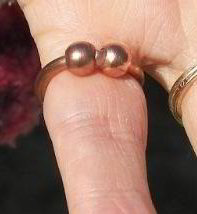
The adjustable Qi
RING band is made of copper and comes with two fixed copper beads
which act as acupressure point stimulators. We chose to leave the
copper band bare as some people believe that the copper is an aid to
healing other ailments, but if you want to you can seal the whole
ring with lacquer - either one of the many spray types available for
metal or even the brush on, clear nail polish type.