| That day, I went to the air force in Vancouver and
tried to enlist as a pilot. Two problems...you had to be
a university graduate…(I had Grade 10)…or have
a pilots license. They were not enlisting anyone, nor
were the Navy, which I tried next. However the Army was
broadcasting on the radio that if you could type or take
shorthand, report to the Armories. I did that and waited
around for an hour or so....no one knew anything about
enlisting. The same day, it was announced on the radio
that the R. C. M. P. was going to send 100 men over to
England as an advance group to control Canadian
servicemen as they arrived. I went to the R. C.M. P.
office and asked about enlisting.....an old Sergeant
looked at me and said words to the effect..."Are you
yellow?.....Why don't you enlist in one of the
services"? All this on the day war was declared. After going to the R. C. A. F. many
times, I got into that service as a clerk with a trade
grouping on Nov. 4th 1939. Along with the others, we were
the first to enlist in Vancouver. R.50592 was my Airman's
number. We were sent to #1 Manning Depot in Toronto. It
was to become famous because we were quartered in the
Exhibition grounds in the building that housed various
animals. I think the one we were in was the pig
enclosure....the stench was overwhelming.
After two weeks there, I was posted
to Trenton, Ontario in the orderly room of #1 Wireless
School. My first two weeks were spent making up fake
invoices. The Air force was still under peacetime
regulations, which required them to get at least two
prices on any item to be purchased. They needed some
equipment immediately, so they bought it and I made up an
invoice to show a higher price for the same item from
another source.
In late November or early December,
I was selected along with 7 others to go to Montreal to
open up the new #1 Wireless School on Queen Mary Road. We
were to the building occupied by the "Gray
Nuns". They were late take over moving out, so we
were quartered in an auxiliary air building on De
Boullion St. This happened to be in the heart of force
the "red light" district. Flight Sergeant
Jacques was in charge of us and would take us on marches
to fill in the time. The "ladies" would call
out to us and say "Come on in .... it's free".
F/S Jacques would say "Eyes straight ahead". No
one got any free passes, even though the air force was
exceptionally popular at the time.
When Conscription came in later
years, we were very unpopular. When we finally got into
the building, I was put in charge of the orderly room. I
promptly put myself in for the highest trade grouping and
for promotion. I did this just as soon as the last
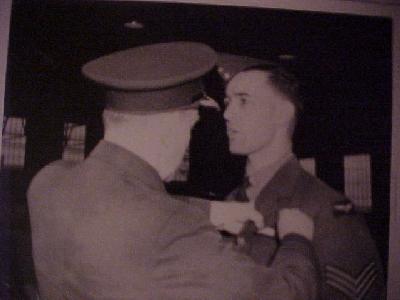
promotion was granted and in only about 6 months, I
became a sergeant. At that time, you were supposed to be
at least 3 months in each
rank.....AC2.....AC1...LAC.....Cpl....Sgt. The British R.
A. F were coming in to train the new students. I met an
R. A. F. Sergeant from India who had been in the service
for 25 years to get that rank....and we Canadians were
higher paid. It took me just 6 months to achieve the same
rank.
I grew a small mustache which was
popular in the air force at that time. It made me look
French or Jewish. One day, I got into an elevator with a
French Nun. She spoke to me in French so I kept nodding
until she got off the elevator.... didn't have a clue to
what she was saying. The R.C.A.F. and R.A.F. were know as
the Bryl Cream Boys....because our hair and mustaches
were smoothed with Bryl Creme.
A senior N.C.O. was needed for
Eastern Air Command Headquarters in Halifax, so I was
sent there and promptly recommended myself for promotion
to Flight Sergeant. The orderly room was the hub of any
station. All orders emanated from it through an adjutant.
By 1940 I was an old hand. The adjutant officers were
much newer to the service and were mostly unsure of their
duties. The adjutant at Eastern Air Command Halifax never
signed anything until we talked it over. Therefore, it
was easy for me to recommend myself for promotion. I had
two F/O adjutants in Halifax…a F/L F.F. Fatt and a
F/O Guymer. I got so that I could sign any document with
their signature as good as they could themselves.
When the Germans overran the French
and the English, and were threatening to invade England,
the British decided to send their gold reserves to Canada
for safekeeping. It came in several shipments. An N.C.O.
friend of mine in the wireless room found out that a
shipment was arriving that day…we didn’t know
that gold was involved…but it was a Royal Navy
battleship, so we decided to go down and see it dock.
There was very heavy security… only uniformed people
around, although there were stevedores working some ships
a block or two away. The area had ex-veterans enlisted
with the Royal Canadian Mounted Police for guard duty. As
we were walking toward the dock where the battleship was
to tie up, a stevedore started walking toward the ship. A
RCMP guard ordered him to stop… I don’t think
the stevedore heard him, so the RCMP guard shot him in
the back. He died instantly. We stayed around for a few
minutes and walked on. Nobody stopped us. It made
headlines in the next day’s paper. The young
stevedore was engaged to be married. The paper stated he
was lying in a pool of blood…there wasn’t a
drop that we saw.
Halifax was surely in the war
zone for merchant seamen. Ships would often come in with
huge holes in them, mostly in the bow area. My brother
Jim came in one day on his way to England. He and several
of his friends had sent their laundry out for cleaning.
The next day they were shipped out, but they got in touch
with me, and I inherited a bunch of laundry.
I caught an ride in a Hudson
bomber one day out of Dartmouth. They were on an
antisubmarine patrol out from Halifax…se saw
nothing. I met a young Free French sailor from the
submarine “Surcouf” and he took me on a tour of
the sub. They went out on a mission a few days later and
were sunk. Rumours abounded…they were sunk by a
German sub…they were really giving information to
the Germans, etc. Some Free French were still in Sympathy
with the Vichy French. Possibly they were sunk by our
forces…anyway, I’ve never heard what really did
happen.
The US. Government sent 50 overage
destroyers to the allies through Halifax I wrote to Mom
and Dad about it and the mail was censored. I just
received a warning not to write about Halifax events
again.
I had two opportunities to go
overseas. The first with the #1 Royal Canadian Air Force
aircrew group. I’d get a commission, but no chance
of flying. Then the army sent us a request for senior
N.C.O.’s for tanks. We’d be commissioned, but
that just wasn’t my cup of tea. A communication came
in to Eastern Air Command Headquarters from Ottawa
stating that only two N.C.O.’s could be recommended
for aircrew training. The notice came to me first for
action. Eastern Air Command Head Quarters comprised of
Newfoundland and all the eastern provinces. I got in
touch via Teletype with a good friend, Andy Huchela, a
Sgt. In the Wireless D/F station in at Yarmouth, N.S. He
asked me to put his name in along with mine. We had to
have reports on our qualifications sent in to Ottawa. As
only two applicants were asked for, I made up excellent
reports and sent them off. We got a reply stating that we
were accepted, but the marks given were far above that
was expected. (I had both of us in the 90’s). The
next problem was to pass a medical test. I failed because
of very high blood pressure. I knew the Dr. so asked if
he could help me. He said he would give me a pill. I was
to go into his office early the next day, take the pill
and lie down on his medical bed and try to relax. It
worked and I was on my way to Belleville, Ontario for
Initial Training School…ground school subjects. At
the end of the course we were selected for pilot or
observer (later changed to navigator) or wireless gunner.
They were very short of observers at
that time, and because I had high marks in math, I was
selected as an Observer. I went to see the C.O. and told
him if I couldn’t be a pilot, I wanted to be put
back to ground crew. He relented and I went to St.
Eugene, Ontario to train on Fleet Finch aircraft. They
resembled World War 1 biplanes.
We were given white flashes to wear
in our caps. This denoted that we were aircrew in
training and gave us a considerable edge over ground crew
with the local girls. Then the ground crew started the
rumour that anyone with the white flashes HAD to wear
them…it showed that anyone with the
“flash” had a venereal disease…our edge
disappeared.
I was the second to solo in my
class…my instructor told me I could have been first
if I had asked. I got a bit of glory from my fellow
students…accidentally. I was sent solo to practice
loops, rolls, spins, etc. I decided to do a dive, pull up
then roll over and go the opposite way. Anyway, I dove,
but didn’t get up enough speed and when I got to the
top and tried to roll, the aircraft stalled and went into
a screaming dive the same way I had started. It must have
looked good from the ground because they gathered round
me later and asked how it was done. I never told them the
truth.
I was sent up another day to
practice aerobatics…loops, rolls, spins, etc.
Another friend was also sent up to do the same. We saw
each other and I flew over to him and ducked under, going
the same direction. I stayed directly under him by about
4 to 6 feet for a few seconds, then I moved and got
directly over him. Also by just a few feet. He knew where
I was and looked up from his cockpit. In looking up he
inadvertently pulled slightly up on the control column.
His “coop” top hit my aircraft very gently, and
scared both of us badly.
When we graduated, we could go to
single engines (fighters) or two engines (bombers). I
thought it would be good to have an extra engine for
safety, so I was sent to #5 Service Flying Training
School at Brantford, Ontario. Pilots were in short supply
and we were pushed to finish the course. We were allowed
4 hours of solo night time flying. On my first take-off
and landings someone crashed on the runway and I spent my
whole 4 hours stooging around trying to get a green light
to land.
Formation flying was part of our
training. When sent solo to practice, we usually headed
for Niagara Falls. We got so that we could get really
close (closer than allowed), then put one wing directly
under the leader’s wing and gently tap his wing with
ours.
There were many washouts during this
course… only about 30 managed to graduate. One of
the failures was a Sgt. Irwin a veteran bush pilot. He
didn’t set his gyro to the true north and un-caged
it in the wrong direction. He was lost and was washed
out.
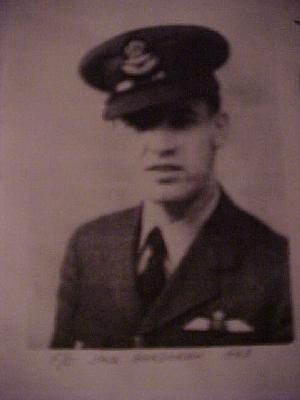
I finished in the top of the class
and was posted to Trenton as an instructor. I went to the
C.O. and talk him I had tried my best to graduate and go
overseas. He said “If we had to keep the bottom
third of the class as instructors, we’d get
progressively poorer students. When I got to Trenton,
there was a group of pilots wanting to go overseas
instead of instructing. This didn’t go over with the
top brass and we were grounded for a week or two and then
sent to remote stations in Canada.
I was sent to Mossbank,
Saskatchewan. We flew mainly Bolingbrokes (Blenheims)
Lysanders and Ansons and Harvards
on occasion. The Harvards were used mainly for instrument
flying. I flew out of Drogue Flight on
Lysanders…there are no dual instructions…you
were told how it flew and away you went. They were very
easy to fly, but impossible to land smoothly. They liked
to jackrabbit all over the field if they weren’t
trimmed the right way. You had to trim it tail heavy
coming in to land and keep the control column firmly
ahead, then they greased in. They also had slats and
slots in the leading edge of the wings. These were
spring-activated and popped out to give extra lift at
lower speeds. Being spring-activated, they world pop out
at different speeds, so you’d get a sudden lift from
one wing or the other and you would come in like a
wounded duck.
My Flight Commander was Johnny
Calderwood (U.S.A) He had an engine failure and in a
panic of sorts, he trimmed the Lysander nose heavy
instead of tail heavy, and when he tried to land the
aircraft went straight in. He was lucky…his scalp
was nearly gone and he broke several bones. At that time,
I became the acting Flight Commander. One of the pilots
told me he flew the Lysander with the drogue deployed and
was able to bounce the drogue off the ground. The drogue,
because of the weight of the cable, was generally some 50
feet below the level of the Lysander. One day, I tried
this …got the Lysander flying a very low altitude
and put it in a steep bank. It seemed the plane was going
one way and the drogue the other. I achieved the feat of
seeing the drogue bounce off the fields. Unfortunately,
the cable crossed the telephone line between Mossbank and
Moose Jaw and took it out. The drogue and cable were
pulled out and dropped to the ground. We raced back to
the field and had a new cable and drogue installed. The
police came and tried to find the culprit, but we were
unable to help.
Two American pilots in my flight
liked to fly an Anson down to the U. S. and pick up
cartons of cigarettes. They would land in a farmer’s
field, get their cigarettes and come back to Mossbank. On
one of their flights, the landing was misjudged and they
ran into a fence. The aircraft was not flyable and they
were in deep trouble when they got an idea. They drained
all the oil out of one engine, then ran it until it
seized, then phoned our station to say they’d had an
engine failure in the air and when forced to land, hit
the fence. They got away with it. These U.S. pilots in a
splurge of patriotism on July 4, usurped a jeep and fired
red and green Very flares all over the station. (These
flares indicated green for landing and red for no
landing).
I learned to really rely on
instruments early when flying in clouds. I flew into a
cloud on an even keel on day…didn’t look at my
instruments…thought I was still flying at the same
level, but came out of the cloud in a screaming spiral
dive. That taught me.
We had a few fatalities at Mossbank.
One pilot tried to roll a Bolingbroke…didn’t
get it all the way around and crashed, killing all his
crew. Another pilot buzzed his girlfriend’s house
and pulled up when she didn’t come out. Then he
aimed directly for the house and pulled up just before
hitting the house. An aircraft doesn’t react
immediately and "mushes” slightly before
climbing. He hit the roof and was killed. Remember we
were very young…18 to 23 years old…and lived it
up.
An Australian pilot, Flight Sgt,
Keen, had a few too many drinks one night and was taxiing
for takeoff when he accidentally pulled the “wheels
up” control and the aircraft ended up on one wing. I
was “investigating officer” to find the cause.
He was a friend and “equipment failure” was my
verdict.
We had a New Zealand pilot by
the name of Shaw…his nickname was “The
sky’s the limit, Shaw”. He claimed he could get
out of the pilot’s seat and fly a Lysander by
standing on the struts. He might have done it, but I
never tried it.
My roommate was Bud Stephens
from Kelowna. He flew out of drogue flight. One night he
asked me to transfer him to the Bombing flight and I told
him I would do it right away The next day, however, he
took the first flight flying drogues…I took the
second. The drogue aircraft would fly along the southern
edge of Lake Johnson, some 15 miles to 20 miles in
length, at 3000 feet and let down to 1500 feet for the
return trip. The gunnery A/C normally had a gunnery
instructor as well as 3 student air gunners. Each
gunner’s ammo had his own bullets colored, so that
hits could be counted. Blue tips, red tips, etc. When the
drogue was dropped at the drogue shack, each
gunner’s hits were then counted. Quite often, the
gunners would finish shooting all their ammo. When
finished, the normal procedure was for the gunnery A/C to
fly close to us and rock their wings to signify the
exercise was over. The gunnery pilots liked to fly under
us and suddenly pull up in front of us and the prop wash
would send the Lysander out of control and scare the
daylights out of it’s crew.
On Bud’s trip down the lake, a
new Bolingbroke pilot evidently finished all his students
and decided to dive under the Lysander and pull up in
front of it. The Bolingbroke kit the drogue’s cable
and drew both aircraft together. Bud’s aircraft lost
an wing and went into a flick spin, from which he and his
operator could not get out. They went straight into the
end of the lake and were killed. The Bolingbroke lost 8
to 10 feet for one wing. 3 of its crew parachuted safely
and the pilot and gunnery instructor managed to get the
Bolingbroke back to base. The drogue operator, I.A.C.
Maduk was on his first trip as an operator. I had taken
him up the previous day to instruct him on how to work
the winch cable and drogue.
It was not unusual to see a tracer
fired in our general direction. Some gunners, on getting
into the turret, would put their fingers on the firing
button before they were ready to fire at the drogue. No
drogue aircraft were hit that I was aware of.
When I found out about the accident,
I went to the C.O. and told him what I was going to do to
the Bolingbroke pilot. The C.O. promptly sent that pilot
to another station and I was sent to represent the Royal
Canadian Air Force at Bud’s funeral.
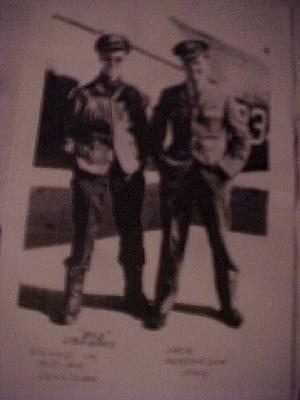
Johnny Calderwood came back to the
drogue flight after he recuperated. He had to fly a
certain number of hours to get his flying pay. He asked
me to fly his trips for a while, which I did. We changed
my name to his after each trip on the log sheets. He said
his “ars” was cutting off washers when he
started flying again.
I then transferred to gunnery ships.
I had flown some 750 hours on Lysanders. That is more
than a month in the air, 24 hours a day. The average time
for an exercise was about 40 minutes, so I made some 1000
plus flights in Lysanders.
I’ve always wondered about
Bud’s reaction time. He was always very deliberate
and took lots of time in making decisions. He would take
twice as long as anyone else in eating his meals. One
day, he and I were taking an Anson 1 up for some
exercise. The Anson was noted for two things…you had
to wind the wheels up, and the brakes were controlled by
bottled air pressure. You could use up the air pressure
very fast taxiing in a strong wind. Bud was 1st
pilot and we started taxiing to a runway. A strong gust
of wind caught us from between two hangars and the Anson
started to turn into a line of aircraft. The brakes
didn’t help and Bud froze on the controls. I reached
over and opened the port throttle full and we did a
complete ground loop, so no damage was done. We shut down
the motors and got into another aircraft.
In addition to flying Bolingbrokes,
I test flew various aircraft that had been worked on by
mechanics. One day, a pilot grounded an Anson 1 because
of power loss on the port engine. It was tested by
mechanics and seemed to have full power. I was to test it
in the air. My usual procedure was to get a Time magazine
and take up anyone who had worked on the aircraft. After
testing, if everything went well, I would get the plane
up to about 5,000 feet, trim it and let the ground crew
fly it while I read Time. The Anson 1 was noted for its
inability to climb on one engine, and in addition, it did
not have a hydraulic system to raise the undercarriage.
It took some 150 turns of a handle to get them up. I took
off under full power and got about 10 feet into the air
when the port engine cut out. I had already started a
mechanic cranking up the wheels. I closed the port
throttle and opened it several times, giving us a little
power, which kept us in the air. However, the starboard
motor started to show that it would no give full power
much longer…it was overheating. We had gone about 20
miles by this time at about 15 feet. Lucky for us, there
was no obstruction in our flight path. I was able to skid
the aircraft slightly to change direction. If I had
attempted a turn of any kind, the wing would have caught
the ground. Pilots were taught in the event of engine
failure on take off, never to attempt a turn under 500
feet. I got the wheels back down and barely made it to a
farmer’s field and landed safely. When the port
engine was tested again, it had 3 cracked cylinders,
which only showed up under flying conditions. We had
landed close to a place called “Ticville”.
I’ve never met anyone, even from Saskatchewan who
has heard of it. Fellow pilots were congratulating me in
the Officer’s Mess when the chief flying instructor
came over to me and said…” I should ground you,
and you know why!” The rule was, if you had to land
anywhere but at an airdrome, you landed wheels up. You
can replace a plane, but not its crew. He was right, but
he really didn’t mean he’d ground me.
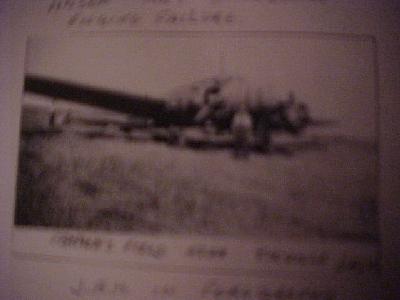
Yes, that's me and the wounded aircraft at Ticville.
One day while testing a Lysander,
there was an extremely strong wind blowing. I got the
plane up to about 5000 feet and pointed it in the
direction I thought the wind was coming from. By cutting
the power to just keep the plane from stalling, I
actually flew backwards across the station.
Vic was born during this time at
Moose Jaw. I was living in the town of Mossbank and
commuting to the base. I used to fly over the house at
about 200 feet to see if Vic was in his carriage enjoying
the cold. We had a new Commanding Officer come on to the
station, and he was super strict. He had a rule that
anyone living off the station had to sigh in before 7:30
A.M. including officers. A friend signed in at 7:29, so I
signed in at 7:29 & 30 seconds. I got a week’s
orderly officer for that.
I was asked to test a Lysander
(single engine) one day. I took off and at about 100 feet
the cowling broke loose. If it came off, it would hit the
cockpit. I reduced the power to just stay in the air and
made a circuit at 100 feet. No problems. A mechanic had
forgotten to secure the cowling with a cotter pin. If I
had reported the mechanic, he would have received a short
term in the brig.
I discovered a gold mine at
Mossbank. We would play rap rummy during our lunch breaks
and after the last flights of the day. Any winning was
entered into a bridge book…you were allowed to lose
up to $5.00 per day. On the Officer’s payday, I
usually had a fairly good credit…even after mess
bills, bar tabs, laundry, etc. was deducted.
I finally got an overseas posting to
Burma. The Medical Officer called me in a said he knew I
was up at night drinking milk…I had ulcers. After a
medical test, he wouldn’t let me go because
“there’s no milk available if you’re
downed in that area”. So I got a “plum”
posting to the experimental station at Suffield. This
station was primarily engaged in germ warfare, both
chemical and biological. By 1945, Canada was poised to
inaugurate germ warfare against Japan. McKenzie King, our
Prime Minister, fearing an attack by the Russians,
stockpiled over a ton of botulinus toxin. At that time it
was the most deadly biological chemical known. There is
an excellent book out on Suffield by John Bryden, Deadly
Allies: Canada's Secret War 1937-1947 (Toronto:
McClelland & Stewart Inc., 1989).
There were only 3 pilots at Suffield
and we could goof off as long as we were available for
any assigned tasks. One of our jobs was to fly scientists
and Army Officers to various establishments. I had to
take an Army Officer to Wainwright, Alberta, in a
Lysander. There was no field at that time, so we landed
in a gopher-holed, dried-up lake bed. To show off to the
army, I came in at a very high speed, but used up the
entire lake bed…an Army Sergeant put me in my place
by telling me that I had used up more of the lake bed
than any other pilot had ever done before.
Another time, I had to take a
scientist to Calgary. There was thick ground fog all the
way. After adjusting for a supposed wind, I came out
right over Calgary without the help of radar, etc.
I had to pick up a Group Captain in
Regina and take him to Calgary. I had developed a new way
to take off in a Bolingbroke without touching the control
column. Instead of opening the throttles with my right
hand I reached across and opened them with my left hand.
I kept the aircraft straight on the runway with the
rudder pedals and with the right hand I trimmed the A/C
slightly, nose heavy and it just floated off the ground,
then at this time I used the control column. When I got
back to Mossbank, the C.O. called me in…the Group
Captain had phoned to say it was an excellent takeoff,
but never do it again.
One of the scientists asked me to
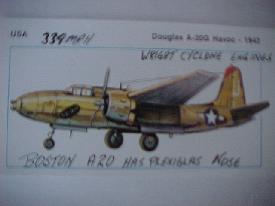
take him for a ride. I put him in the nose of the Boston
(A.20). It was a bad place to be if you had an accident.
We went over to the Brooks irrigation district and I
noticed a group of German prisoners of war who were
gathered together. The patches on their backs easily
identified them. To give the scientist a thrill, I dove
on this group at about 50 feet. And made the Germans dive
for the ground. I thought it would be great to do it
again and came back at about 25 feet. They were ready
this time and as we approached, they all threw something
into the air…rakes, shovels, stones…and they
just missed. I thought I’d be grounded if the C.O.
heard about it, but nothing happened.
Another time, I had to take a Boston
up for some tests. I did the usual mental check list that
I had been taught. If I remember right, it was
H.T.M.P.F.C.O.G.G.S
H…Hydraulics working
T…Trim for take-off
M…Mixture
P…Pitch..fine for take-off,
course for normal flight
C…Cylinder head temperatures
O…Oil pressure
G…gills closed for take-off,
open for normal flight
I forgot the last G& S.
Later, a clipboard was substituted
and you checked them off. Anyway, I checked everything
and away we went…airspeed was very slow in getting
up to take-off. We were running out of runway, the nose
gunner was hollering at me to get it up…it was on
full power…we got to the end of the runway and I
hauled the control column back and we staggered into the
air. Something was wrong. I checked all the
instruments…we finally tot up to about 300 feet and
then I noticed someone had left the supercharger (new to
me then) in “high” blower. This meant the
engines were getting too much air. I quickly switched it
to “low” blower and the aircraft dropped like a
stone for a second and then full power came on. After
that, I added another “S” to my take-off
check…S for Supercharger…low blower. Had I
found the problem a second or two sooner (at the lower
altitude) we would have crashed. The reason for a
supercharge is that at higher altitudes, air is scarcer
and the supercharger puts a better fuel/air ratio into
the engines.
The Boston was also the first
aircraft we had with propellers that could be fully
feathered. Up to that time, we had variable pitch
props…you had two positions, fine for take-off and
coarse for normal flying. No one had tried the fully
feathering at our station, so one day, I fully feathered
one engine (the prop turns edgewise to the direction of
flight and causes no drag)…the prop stops turning
but the engine is running. Anyway, I tried turning
against the feathered engine…no problem so with the
prop fully feathered; I flew back to our station at about
50 feet to show off. Apparently the ground crew thought I
was having an emergency and out came the crash
tenders…fire trucks and ambulance…no problem.
Another time, another pilot and I
took the Mitchell (the type used to bomb Tokyo for the
first time) for a four hour tour of North Dakota and
Montana. We got hell when we got back because of the huge
amount of fuel consumed.
We also experimented with mustard
gas and other poisons. We may have been the first to
spray green fields with a defoliant. We had huge land
areas, so no one was endangered as long as we were sure
of the wind direction. Bacterial warfare was probably the
main thrust of the experimental station. Anthrax, a fatal
disease to cattle and humans, was being tested for use
against troops, etc. They developed a gas…anthrax
mixed with distilled mustard gas. The mustard gas would
cause blisters on the skin and the live anthrax spores
would enter the body through these blisters. I did not
knowingly participate with anthrax experiments, although
I was inoculated against it in case we came in contact
with it in a forced landing, etc. (I say knowingly
because we only knew about tests by a code name or
number, not by real names)
This inoculation took place in a
special room set aside for this purpose. I was told there
would be a violent reaction for about 10 minutes. Anyway,
for about 15 minutes I thought I would die. My whole body
felt like it was burning up. It eventually subsided.
Medical people were on hand if required. One of my
friends had the same inoculation. He said it was like a
hot poker was thrust into you and your body was on fire.
The biggest test with mustard gas
came late in the war. Conscientious objectors were used
as guinea pigs…these troops would do anything for
the country except fire at an enemy. They were placed in
a huge field. Most of them had holes cut into their
uniforms in various places…e.g.…a leg missing,
a crotch cut out, a shoulder cut off. By the way, they
got an extra 65 cents a day danger pay for this.
Ambulances, Doctors etc were standing by to look after
anyone in distress. (I forgot…they had gas masks
on). It turned out the ones that suffered the most were
those with sweat areas missing from their
uniforms…under armpits, groins.
In 1944, one of the Germ Warfare
scientists came up with the idea of raining showers of
poison darts on test animals, mainly sheep and goats.
These animals were dressed in 3 layers of heavy serge to
simulate a soldier’s uniform. Some of these darts
did penetrate up to 6 inches into the flesh, if it did
not hit a bone. The bombs were usually a 500 pound
cluster type. These held approximately 30,000 darts and
an area of 10,000 square yards would be covered.
It was decided to have a large-scale
test with these darts in late 1944. I was chosen to be
the pilot of a Boston A20 to drop the bomb. This bomb, I
believe , was to detonate at 1,000 feet above ground
level. Scientists from Canada, U.S.A. and England were on
hand. The aircraft was at 10,000 feet and approaching the
target area. The bomb aimer gave me the usual
instructions…left..left…or
right…right..then steady, and then bombs away. We
had done everything right, except we did not open the
bomb bay doors. Normally, the bomb aimer starts with
“Bomb bay doors open”…which the pilot
repeats and then the pilot opens the doors. In this case,
I started cursing the bomb aimer and he returned the
compliments. We were on an open mike to the ground.
Anyway, we went around and did it right the second time.
Some 14% of all the tethered animals
were killed. A good test a British Major remarked at a
briefing a few days later, but then said “do you
realize you could have achieved better kill results with
just one high explosive shrapnel shell bursting at the
same height”. The tests were discontinued in early
1945.
The last inoculation I had turned
out to be for Rocky Mountain Spotted fever. This disease
is characterized by high fever, pains in the joints,
bones, muscles and skin eruptions…the disease is
transmitted by ticks.
To get the serum to inoculate you, they would grind ticks
in a formaldehyde solution and inject it straight into
you. I think the reasoning back of this poison was that
it would be possible to lace this disease with anthrax
spores and drop it by way of a bomb over the enemy. The
Spotted Fever would cause lesions and the anthrax was
then fatal.
A brand new Anson 5 was delivered to
our station. I wanted to be the first to fly it, so I
loaded it with ground crew and went for a flip. After
about ½ hour we came in for a landing. There was a
strong wind blowing across the runway from the left.
Anyway, as we touched down, the aircraft took a jump to
the left and almost caused a ground loop. After getting
down and reading the literature on the aircraft’s
characteristics, I came across the
following…”Notice... This aircraft has a
tendency to swing left on landing”.
The strong cross-wind just
re-enforced this for me.
One day while flight testing the
Boston, I put it into a steep dive to see how fast it
would go…at the time 250 to 350 miles per hour was
fast. I got it up to well over the 450 mark on full
power. The m.p.h. needle showed well into the red danger
zone. I was thinking that not many people would ever go
that fast…how times have changed.
We had a “:Tiger Moth” on
the station used mainly for weather checks. It had a
warning on the instrument
panel…”Caution…this A/C not stressed for
aerobatics”. Anyway, I used to take up a ground crew
in the rear seat and do loops, spins, etc. …no
problem. We also had a Norseman on the station… an
amazing airplane…if you could squeeze it in, no
matter how heavy, it would fly. The famous bandleader of
the day, Glen Miller, took off from England in a fog
bound for France in a Norseman with an American pilot
…they were never heard from again.
A War Bond drive came to all
stations…a movie star would visit the station that
sold the most per individual. Ours was a small station
and I was nailed to organize the sales. I interviewed
every person on the station and we did win. The star who
came was Gail Patrick, a beautiful lady. The photographer
wanted to get a picture of her, with me in front of an
aircraft. I had my arm around her back when she said
“why don’t we get everyone in the
picture?’ Some seconds later, I was 8 people away
from her when the picture was taken. Gail Patrick starred
in the Maltese Falcon and also the Hit Parade of 1951
The only time I got home during 1939
to 1945 was the time my brother, Jim, also got leave. He
had just finished his 2nd tour in North
Africa…he was a Wireless Air Gunner. Jim was to be
on leave until he received notice that he was to return
overseas. We had an enjoyable 9 days and one day the
phone rang..the 10th day. Mom answered…a
girl from the telegraph office of the C.P.R. was on the
line. (Mom did not want Jim to go back overseas)
. The girl said “ I have a
telegram for Mr. Henderson”.
Mom replied “which one, there are three?”.
“Mr. J Henderson” said the girl.
Mom replied “which one, there are two?”.
“Flying Officer J. Henderson, the girl persisted.
Mom replied “Which one there are two?”
The girl was a little miffed by this time and said
“Flying Officer James Henderson”.
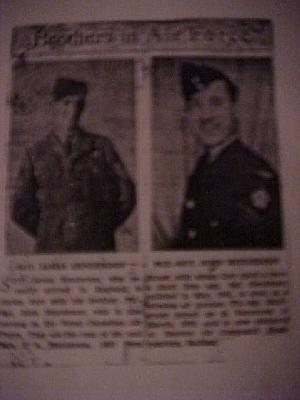
Jim died recently and the Air
Gunners Association wrote this in his obituary: Jim had
the occasion to fly for 4 air forces during the war. He
flew with the R.C.A.F. He was attached to the R.A.F. and
did a tour out of England. He was posted to North Africa
and did a tour with the Royal South African Air Force.
The fourth air force he flew with was a very short
flight. He was returning from a shipping raid when the
pilot noticed a group of aircraft flying toward their
base. He joined up with them for protection and when they
got close, noticed that the planes were German. The pilot
immediately put the plane into a steep dive. The Germans,
if they noticed at all, did not pursue. The Air Gunners
Association noted that Jim’s aircraft was the first
plane to exceed the speed of sound in a dive.
Jim’s favourite story about
North Africa was about the metal he received for saving
over 50 lives. When asked what the metal was for he
replied “ I shot the cook”. (I like the story
so much I use it myself).
The war in Europe came to an end and
the Royal Canadian Air Force started to think about the
future. The pilots at the Experimental Station at
Suffield were asked …”do you want to stay in
the Air Force or not? We want to get good replacements
for any of you who do not want to stay”. I elected
to get out and have been sorry about that decision ever
since.
This poem expresses my feelings for
flying and my time in the Air Force.
High
Flight
by John Gillespie Magee, Jr.
Oh, I have slipped the surly
bonds of earth
And danced the skies on laughter-silvered wings;
Sunward I've climbed, and joined the tumbling mirth
Of sun-split clouds...and done a hundred things
You have not dreamed of...wheeled and soared and swung
High in the sunlit silence. Hov'ring there,
I've chased the shouting wind along, and flung
My eager craft through footless halls of air.
Up, up the long, delirious, burning blue
I've topped the windswept heights with easy grace
Where never lark, or even eagle flew.
And, while with silent, lifting mind I've trod
The high untrespassed sanctity of space
Put out my hand, and touched the face of God.
(click
for poet information)
|