Historically,
commercial fish hatcheries have experienced limitations including:
-
problems
associated with supply and with moving copious amounts of water
-
keeping
the fish disease free
-
maintaining
an oxygen and temperature level to its optimum
There has
been a constant effort to methods to improve or changes made in practices in
aquaculture. In the past, copious amounts of water were used to ensure the
removal of metabolites during the hatching process and the replenishment of
oxygen supplied to the eggs. It was thought that through a system of
appropriate proprietary filters, ultraviolet disinfectant, and ozone-oxygen
stripping-generation system, a compact closed system could be built.
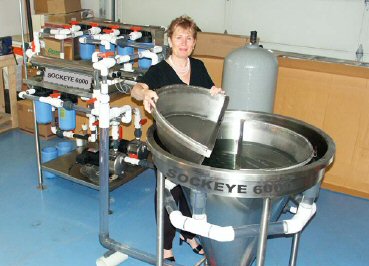
For the past eleven years, Ken and Sheila Klushin have been developing and
improving the Sockeye 6000 system that is totally enclosed and requires very
little water use, compared to previous practices. By the development of a
closed aquaculture system that can be operated almost
anywhere, water resource and disposal problems become minimal.
Re-circulating aquaculture systems can use existing ultraviolet and ozone
technology economically.
The dependency on large volumes of water to replenish oxygen level and to
remove metabolites and other
fishery waste products is eliminated by a series of filters, together
with ultraviolet and ozone
generators. Because of the low volumes of water used, the system can
be configured in such a way
that it can maintain the water quality with high oxygen content at a
lower cost, as well as more
manageable and more productive hatcheries.
The objective
One of
the difficulties in the past in the use of ozone as a disinfectant and the
source of oxygen was
the requirement of a high out-put ozone and expensive units to achieve
satisfactory disinfecting.
At the same time some undesirable soluble toxic oxides of nitrogen were also
detected in the water. By
incorporating an ultraviolet unit and proprietary filters, a lower ozone
output unit on demand can be
used and the level of oxides of nitrogen was reduced to minimal.
Experimental
work continued on the Sockeye 6000 to optimize the economical use and the
application of the
ultraviolet and ozone technology in the enclosed re-circulating system,
together with
proprietary Sockeye 6000 filters. The by-product of the ozone stripper is
pure oxygen, thus the
oxygen level in water is automatically maintained after the destruction of
the toxic metabolites
from hatching eggs or salmonid grow-outs. Therefore, the use of ozone has
accomplished these two objectives in a single step.
Chemical
analysis performed on the Sockeye 6000 indicates that the ozone stripper is
performing as expected, that
is:
-
no
residual ozone or oxides of nitrogen are found
-
the
oxygen level in water was above 11 ppm @ 10 degrees centigrade
-
the
biological loading and the toxic metabolites are found to be negligible
-
eliminating
the use of pharmaceuticals
When the
target Sockeye 6000 test results were achieved, application for a license to
operate such a hatchery was made. The license officer visited and
subsequently issued a fish hatchery license in Alberta in a RESIDENTIAL
area. Similarly, a commercial fish hatchery license was issued to for the
Sockeye 6000 in British Columbia.
A
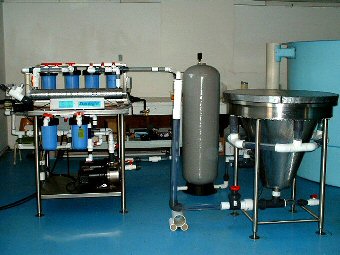
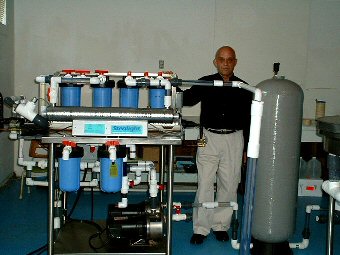
showcase Sockeye 6000 prototype hatchery is set-up in Chemainus, BC
demonstrating a state of the art compact re-circulating fish hatchery.
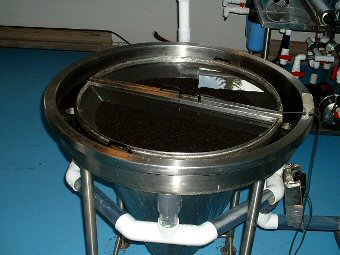
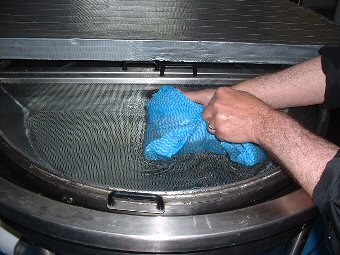
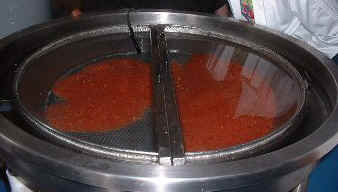
The
Sockeye 6000 has a hatching capacity of 100,000 eyed eggs per hatching
basket that can be attached to heath trays and other types of hatching
baskets with only 100 gallons or 400 litres of water re-circulated in a
closed system. The hatchery is designed to be housed in a 15 x 15 building,
equivalent to a single garage. Controlled water temperatures and oxygen have
produced a 90 - 95 percent survival rate on live eggs (eyed eggs). As this
closed loop system produces no environmental waste, it is much easier to get
a government fish license to operate this hatchery in most Provinces.
Using Sockeye 6000 technology, this turnkey fish hatchery can be set up in a
residential or commercial garage and operating in less than 60 days. Aqua
Zone will supply a fish hatchery technician for the first hatching on the
Sockeye 6000.
Aqua Zone
is committed to the Sockeye 6000 re-circulating salmonid hatchery and other
aquaculture systems. We look forward to improving the technology needed to
grow safe food fish indoors and in an environmentally friendly manner.